 Blue_Speed
Bambu Lab recently made a new printer called the A2L, a large-format bed slinger costing $469 for the base version and $569 for the multi-color option. It's the biggest printer they've made at that price. The only printer with the same build volume is the H2S, which at its cheapest is $1,199, twice as expensive for a slightly bigger build volume. The A2L comes in at about 330×320×325mm, while the H2S is 340×320×340mm. So what, 1cm on the X axis and 1.5cm on the Z? That's not a big difference, or at least not $1k worth of one. The H2S has other features, but I digress, here's the main thing.
The Name
What does A2L mean? Pretty simple: the L means Large, and the 2 means it's a second-generation product. The A is trickier. I could give you some theory about the A being there because it's the cheapest, most beginner-friendly printer in the lineup, but that's not quite it either, since H comes before P alphabetically and the H series printers are more expensive. The real reason is simpler: A series is just the name Bambu Lab gives to their open-frame bed slingers, their cheaper printers made for beginners getting into 3D printing.
The Specs
Now that we understand the name, let's get into it. The A2L is the large version of the A series, so naturally it's big, about 330×320×325mm. Not the optimal 350 cubed, but large nonetheless. It also has a stainless steel nozzle that heats up to 300°C, so you can print the basics comfortably, and technically you can print ABS and ASA too, though it's not recommended. Why? It doesn't have an enclosure, and without one, ABS and ASA can't stay stable on the build plate for long periods.
It also has a max speed of 500mm/s, but you're not getting that unless everything's dialed in perfectly. A higher max speed should mean a higher base speed too (looking at you, Anycubic). Realistically, you're probably printing at around 250mm/s, which is still fast. For comparison, the Prusa Mini's max speed is 200mm/s.
Why the "2"?
Now I have a small gripe about this printer, big enough that I'm making it the title: why is it called the A2L? My theory is marketing. It released kind of late, and they probably figured that since all their printers are wrestling with the number 2 (H2D, H2C, H2S, X2D, P2S), those being actual second-generation products, the A2L should fall in line too. (I don't love that the H series has a 2 either, but that's a blog for another day.) The A2L's biggest difference from the A1 or A1 Mini is that it's bigger, which isn't a new feature. It does have Dual Granular Dampeners, which in simple human words means the frame absorbs vibration, and adaptive vibration compensation, so it can adjust to its surroundings, okay. And the biggest thing: it works with the cutting module, so instead of buying an H2D or H2S to cut paper (or a Cricut), you can just get the A2L. Not the best reasons to call it a second-generation printer. Some people say the A1 and A1 Mini are second generation, in which case just rename them, or better yet make them "A1" across the board, since they're the first generation of the A series. You wouldn't name a new phone "26" just because it has features that happen to be made this year. Doesn't make sense.
For what it's worth, the A1 Mini and the regular A1 are pretty similar to begin with, just the size, so I get why the naming gets confusing once you throw a third size into the mix.
Cons
- Locked-down ecosystem. Bambu is owned by Bambu, and they run such a locked-down ecosystem that you can't really improve on anything if there's a problem. The problems are minimal, but if you want to add or change something, you can't. It's just not possible. It's so locked down that you can't even use Orca Slicer, which is 1,100% better than any slicer I've tried.
- It's a bed slinger. To hit this price, they had to make it one, and because it rocks around, tall prints are harder to pull off, and even long prints can be tricky since the print can just detach when it wants to.
- Maintenance can catch you off guard. It can break, and sometimes you just don't understand how to fix it. It takes time to fix, and a maintenance routine is the best way to prevent that in the first place, but it's hard to put a maintenance routine together. That's why I'm building a tool for exactly this, though it'll take a while since every printer needs its own full system, so bear with me.
- It's not 350mm. This is the biggest problem with it for me, and it's worth its own section below.
The 350mm Problem
330×320×325mm sounds big, and compared to almost anything else near this price, it is. But 350mm is the number that actually matters for prop makers, and the A2L falls short of it on every axis. That gap sounds small on a spec sheet, a centimeter or two here and there, but it's the difference between printing a helmet, a large cosplay piece, or a full prop in one clean piece versus having to split it, glue it, and sand down the seams.
That's really the core of my gripe with this printer. It's so close to being the perfect prop-making machine. Great price, reliable prints, big ecosystem, and then it just barely misses the size that would let it print the biggest, cleanest single-piece props people actually want to make. Because of that, you can't call the A2L the printer for the best props or the perfect prop size. It's the printer for very good, slightly-smaller-than-ideal props, and once you've hit that 300mm-plus wall enough times, the missing 350mm starts to feel less like a rounding error and more like the one upgrade Bambu Lab left on the table.
Pros
- Great price. Honestly, if you need a good prop-making printer, this one is amazing, because it plugs into the Bambu ecosystem and makes building something big possible.
- The Bambu ecosystem. They give amazing rewards to model creators, free printer levels, around 500K models, and they still run competitions to give top modelers free printers and gift cards. So a lot of the models and things you need are already there. You just tap the model you want, slice it, and send it. You can even do it from your phone.
- High reliability. It gives you prints all the time. It won't break every few prints on you, it just works, and that's the new standard for 3D printing: printers that just work.
Comparing: A2L vs. Elegoo Neptune 4 Plus
There's always another printer in the mix that's similar, maybe even better, so let's pull up the Compare tool and check. The biggest competitor here, for me, is the Elegoo Neptune 4 Plus, and the only big differences on paper are price and rating.
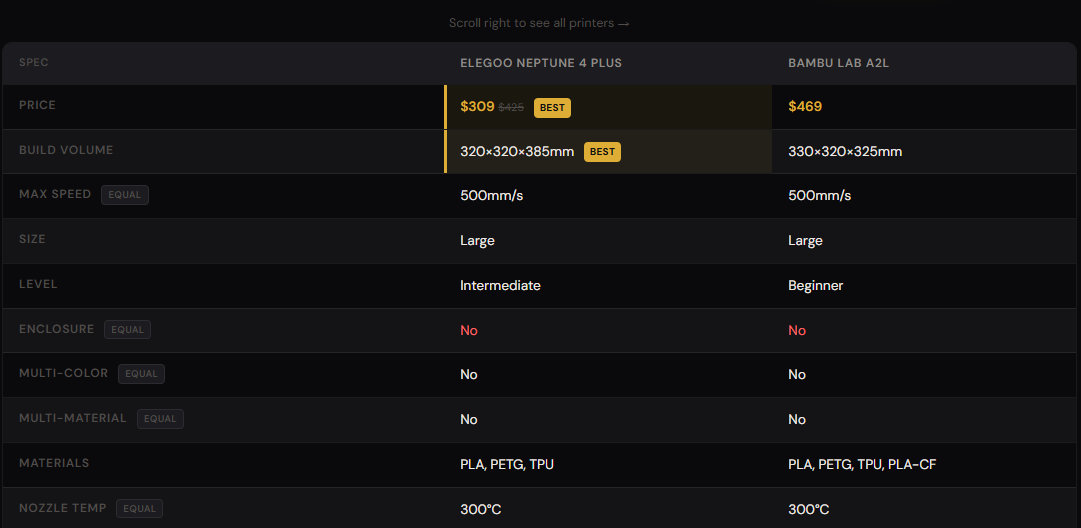
Live version of this comparison: printmatch.netlify.app/compare.html
The Neptune 4 Plus is $309 with a build volume of 320×320×385mm, actually a bit bigger than the A2L's, and it matches the A2L on 500mm/s max speed and 300°C nozzle temp. Neither has an enclosure, neither does multi-color or multi-material out of the box, and the material support is close too.
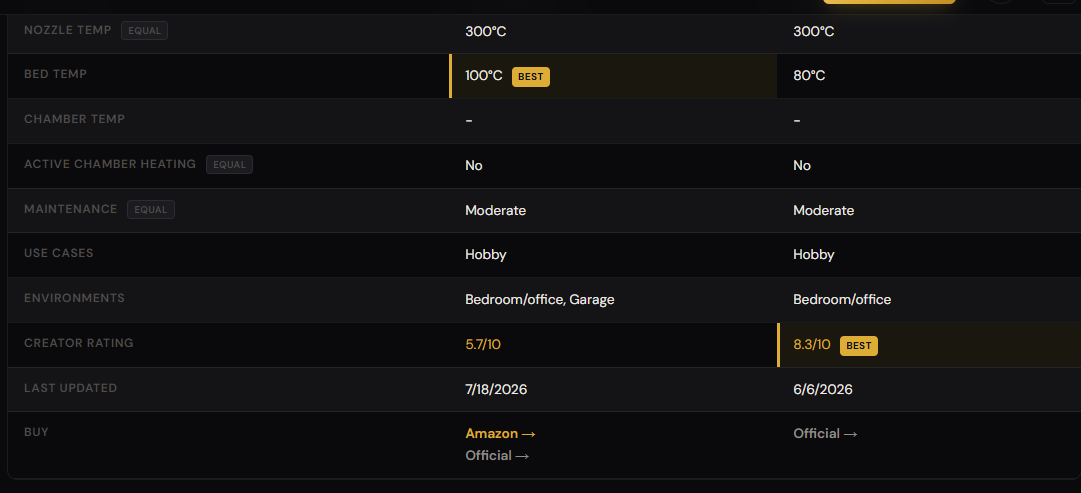
Live version of this comparison: printmatch.netlify.app/compare.html
So why did I rate the A2L so high, 8.3/10 against the Neptune 4 Plus's 5.7/10, when the spec sheets are this close? Here's what the specs alone won't tell you. The Neptune 4 Plus handles big prints well, but when you go small, it doesn't nail every detail. The A2L just performs more reliably across the board. It gets you good prints consistently, in both scale ranges, and that consistency is worth more to me than a longer Y axis.
Who Is This For?
This printer is for prop makers who want smaller props, not the huge ones that only a 400mm printer can pull off, and yeah, that circles back to my issue with it not being 350mm. If you want the biggest possible audience, 350mm is the number to hit. But even more than that, this is for people who want to make things in bulk without paying a very high price, while still getting that Bambu quality. That's the real person this printer is for.
Final Verdict
It's a great printer that doesn't deserve the 2 in its name, sorry, had to say it. It'll print big, it'll print small, it'll print in bulk, it'll do what you want it to do, and it'll do it well. It's just not quite the printer for the biggest or most perfectly sized props out there, so keep that 350mm gap in mind if that's what you're chasing.